

Podcast transcript generator for public episodes

Paste a YouTube, Spotify or Apple Podcasts link. Read, search and export the words from your episode in one place.

Public episode links only. No audio upload is needed.

YouTube, Spotify and Apple Podcasts episode links are supported.

This is what you get back

Explore an illustrative podcast transcript with search, speaker labels, a separate summary and downloads. Try the reading workflow before submitting your own public episode link; timed exports require usable timing data.

After the Funding Stops: Keeping a Community Radio Station Alive

Apple PodcastsThe Quiet Signal491 words3 min 36 sec

Illustrative sample
  1. 0:00
    SPEAKER_00

    Welcome back to The Quiet Signal. I am Mara, and today we are talking about what happens to a radio station after the funding stops.

  2. 0:10
    SPEAKER_01

    Thanks for having me. The short answer is that the transmitter keeps running, but everything that made the station a community disappears within about a year.

  3. 0:18
    SPEAKER_00

    That is a bleak summary. Can you give us a concrete example? Somewhere we can point at and say, this is what was lost.

  4. 0:28
    SPEAKER_01

    Sure. There was a station in the north of the country that ran a nightly programme for local fishermen. When the grant ended, the show went first, then the two part-time presenters, then the Saturday live band.

  5. 0:40
    SPEAKER_00

    And the archive? People assume at least the recordings survive somewhere.

  6. 0:49
    SPEAKER_01

    The archive went with the equipment. There was no budget line for storage, so the drives stayed on a shelf in a cupboard until they were formatted and reused.

  7. 0:59
    SPEAKER_00

    So the station kept broadcasting and the community stopped existing. That is the part I cannot stop thinking about.

  8. 1:09
    SPEAKER_01

    Exactly. Broadcasting is not the same as being a station. You can be on air and still be irrelevant to the people who live within thirty kilometres of you.

  9. 1:21
    SPEAKER_00

    What would you change first if someone handed you money tomorrow?

  10. 1:29
    SPEAKER_01

    Not the transmitter. The archive. If you record everything and store it properly, you have preserved the ability to be relevant later, even during the years when you are not.

  11. 1:40
    SPEAKER_00

    That reframes preservation as an active investment rather than a tidy-up job at the end.

  12. 1:52
    SPEAKER_01

    It is. And it is cheap next to rebuilding a newsroom. Transcription is part of it too, because an archive nobody can search is not really an archive.

  13. 2:04
    SPEAKER_00

    Let us stay on that. You mentioned transcription. How does text change who listens?

  14. 2:14
    SPEAKER_01

    It changes who can find you. The fisherman who missed the 22:00 broadcast can search the transcript the next morning and go straight to the segment. That is not a small group of people either.

  15. 2:27
    SPEAKER_00

    And for the volunteer who hosts the show, does having the text on screen change how they work?

  16. 2:36
    SPEAKER_01

    Enormously. A presenter can read back a caller quote, correct a name before it goes out, and reuse a segment next week instead of re-recording it.

  17. 2:48
    SPEAKER_00

    We have covered loss and preservation. If a station has to choose one thing to protect through a difficult year, what should it be?

  18. 3:00
    SPEAKER_01

    The written record, and the habit of putting something into it every week. Consistency is what makes an archive worth searching later. A perfect night once a year is worth less than a rough night fifty-two times.

  19. 3:12
    SPEAKER_00

    That is a good place to land. Thank you for coming in, and for the archive you are still looking after.

  20. 3:22
    SPEAKER_01

    My pleasure. The next episode is about the recordings from the first winter, which we are finally digitising.

  21. 3:31
    SPEAKER_00

    That is The Quiet Signal. Transcript generated for this illustration; the conversation is fictional.

After the Funding Stops: Keeping a Community Radio Station Alive

DownloadTXTPDFSRTVTT

Every download is produced from this transcript. “After the Funding Stops: Keeping a Community Radio Station Alive” is used for the file name.

How the podcast transcript generator works

Transcribe an episode

Paste the episode link

Copy a Spotify, Apple Podcasts or YouTube episode link and paste it into the field above.

We fetch and transcribe

Spotify and Apple episodes are resolved through the show’s public RSS feed and transcribed. YouTube links are read from the caption track the video already has.

Read, search and export

Search the completed transcript, copy a passage and save TXT or PDF. Choose timed subtitle files when the source includes usable timings.

Built for reading, not just for downloading

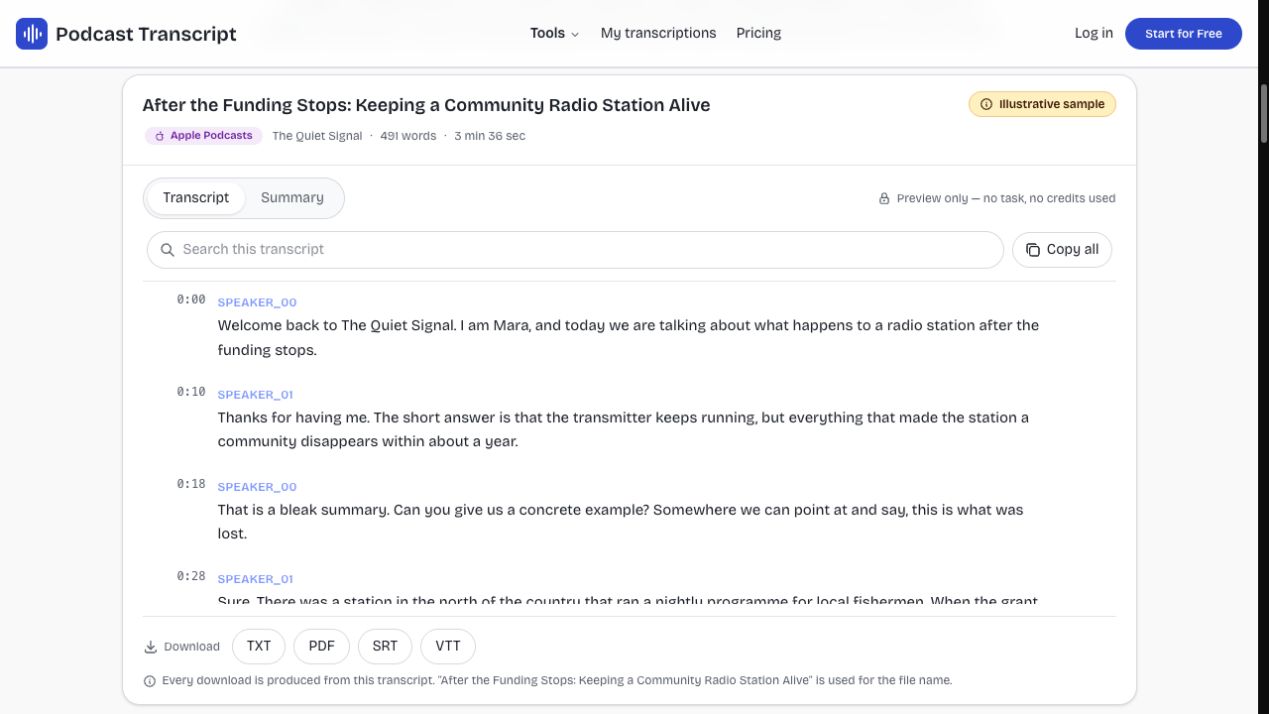
The transcript reader with search, timestamps and speaker labels

Search the words behind the conversation

Find a name, number or claim in the searchable transcript without scrubbing through the player. Read neighboring passages for context, then check important quotations against the recording before using them.

Get a transcript
The finished transcript with its download buttons

Take podcast transcripts into your own notes

Save TXT for notes or PDF for reading and printing. When usable timing data exists, download SRT or VTT for caption tools, all generated from the same transcript.

Get a transcript
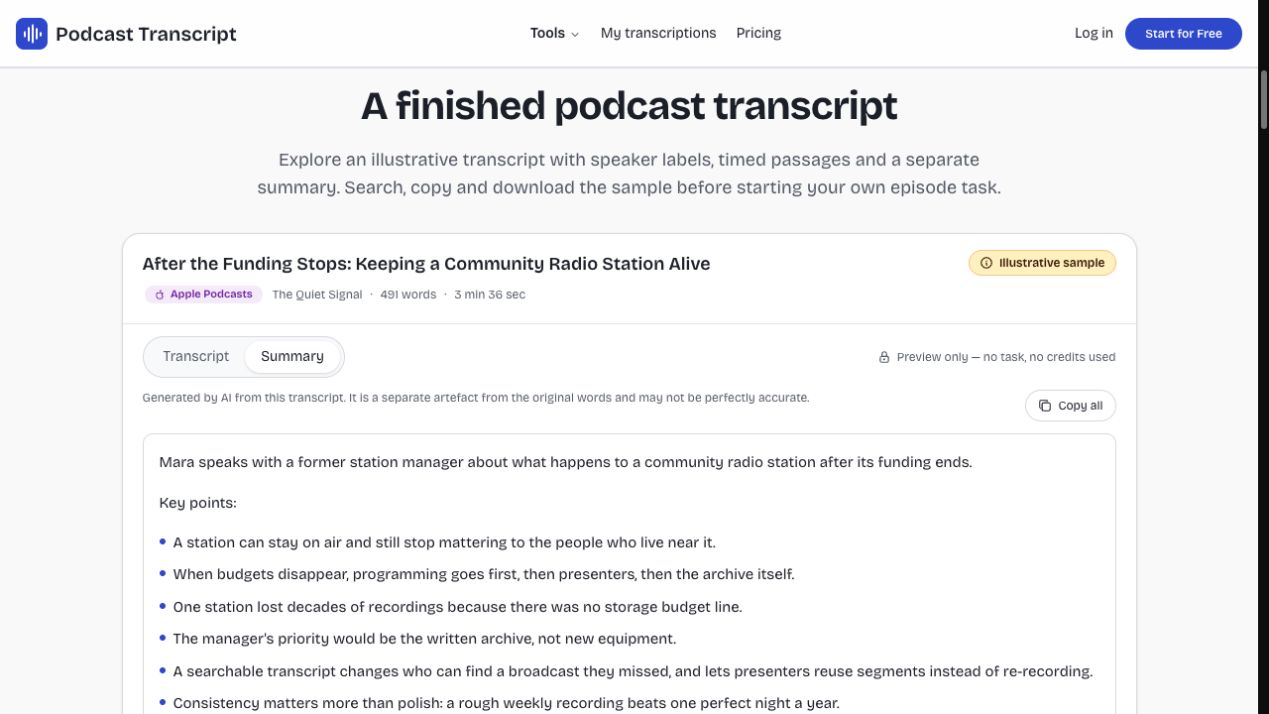
The optional AI summary beside an illustrative podcast transcript

Summaries kept separate from the words

The optional AI overview sits in its own tab beside the transcript. Skim its key points to choose a passage, then return to the spoken words and recording before quoting.

Get a transcript

Less replaying. More useful words.

Take the part you need from an episode and put it to work, with the original transcript always available beside the summary.

Find the passage, keep the context

Find a name, phrase or idea without replaying the whole episode. Read nearby words before quoting, and use timestamps when the source includes timing data.

Take your transcript with you

Save TXT or PDF for your notes and research. Export SRT or VTT when timings exist, and keep a local copy beyond your account retention period.

Start with the overview

Skim an optional AI summary to find the ideas worth exploring. Return to the transcript for exact wording, and check important quotes against the original episode.

From an episode to your next piece of work

Students & researchers

Build notes you can return to

Locate a topic across a long interview, copy the relevant passage and save the transcript with your research. Keep the episode link alongside it so you can check the source before citing a speaker.

Writers & creators

Give your next draft a starting point

Collect useful passages for an article, newsletter or episode recap. Skim the summary for direction, then check the wording in the transcript. Edit and verify your draft before publishing rather than treating automated text as finished copy.

Curious listeners

Read the part you came for

Look up an idea you heard during a commute without starting the episode again. Search the transcript, read the nearby discussion and download the text for later. You can try the sample before creating an account.

Choose the workflow that fits the task

Listening is still best for tone and delivery. A transcript helps when you need to find, read or reuse the words. Here is where each approach fits.

Choose the workflow that fits the task
Listen & take notesRead in the platform appUse Podcast Transcript
Find a particular passageReplay and take your own notesDepends on the episode and appSearch the available transcript
Keep a readable fileWrite and format it yourselfExport options vary by platformDownload TXT or PDF
Create timed captionsType and time each cue manuallyDepends on available caption toolsSRT or VTT when timings exist
Check the original sourceHear the speaker directlyListen or watch in the source appVerify automated wording against the episode

Frequently asked questions

Podcast Transcript home

Start with the podcast transcript generator

Turn one public episode into searchable podcast text, then keep the passages and files your notes, research or writing need.

Get a transcript